
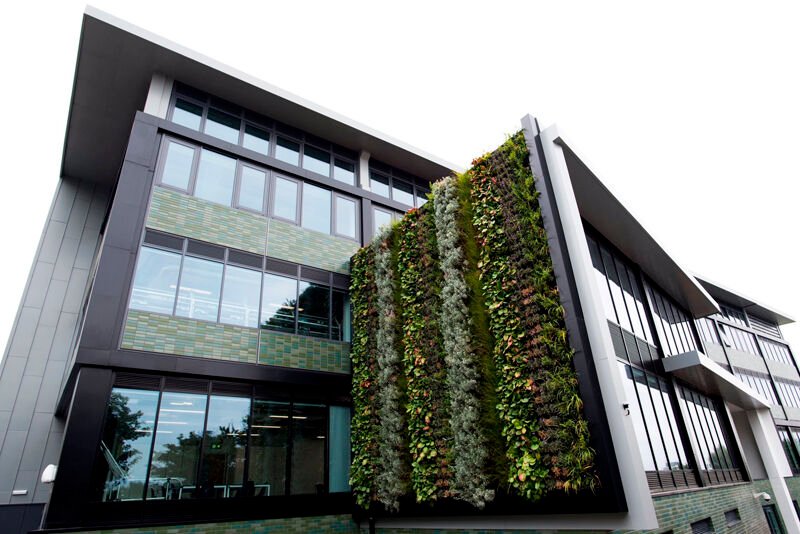
A Rain-Fed Living Façade Supporting Urban Water Management
For this project, Life on Walls partnered with Middlesex University to design and deliver a living façade that would contribute to the university’s Sustainable Urban Drainage (SuDS) objectives while creating a visually striking architectural feature.
The system was designed not only as a green wall but as a functional element of the building’s water management strategy.
The Challenge
Middlesex University required a self-irrigating living façade capable of operating primarily using harvested rainwater. The brief set clear environmental requirements: the system needed to function without reliance on mains water or mains electricity while supporting the university’s wider sustainability goals.
The design therefore had to integrate water collection, storage, and distribution directly into the structure of the living wall itself.
The Solution
To meet these requirements, we developed a multi-layered living wall system functioning as a vertical rain garden.
Rainwater is collected directly from the building’s roof and passes through a filtration layer before entering a series of integrated storage reservoirs within the façade. These channels act as slimline water stores, distributing moisture through capillary irrigation strips that deliver water to each level of planting.
An outer layer of carefully selected plants conceals the internal irrigation structure, maintaining the appearance of a traditional living wall while enabling a highly efficient and self-sustaining irrigation system behind the scenes.
The Result
The completed installation forms a 100-square-metre living façade that wraps around four corners of the building, creating a distinctive green architectural feature.
Approximately 75 percent of the system’s irrigation needs are supplied by gravity-fed rainwater, significantly reducing reliance on external water sources. A low-impact backup system supports plant health during extended dry periods.
The project delivers multiple long-term benefits, including improved biodiversity, reduced water consumption, and lower energy use. It also strengthens the building’s environmental credentials while demonstrating how living architecture can support sustainable urban infrastructure.
If you are exploring how living walls can support water management, biodiversity, or long-term asset performance, contact our team to learn more about our design and installation services.